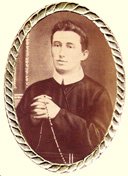
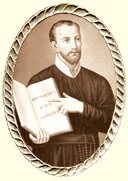
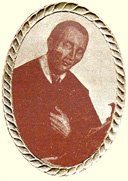
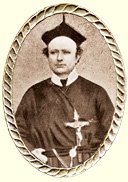
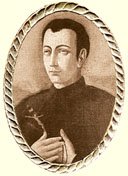
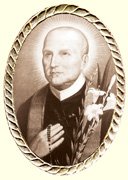
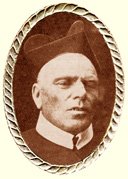
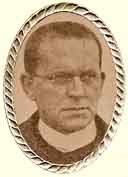
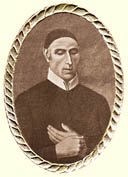
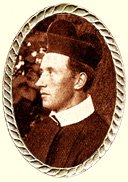
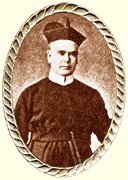
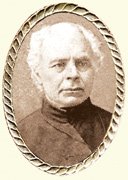
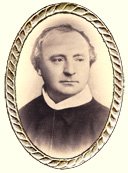
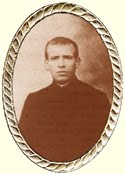
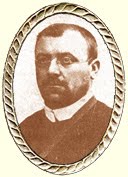
Father D. Paul Cafaro was born on the 5th of July, 1707, in the diocese of la Cava, and in a place called after the Cafari. His father was called John Nicholas Cafaro, and his mother Cecily also bore the name Cafaro. Cecily was a woman of great piety, and her husband led a most exemplary life although only a secular. He belonged to a congregation the obligations of which he never neglected. He was much given to mental prayer, and he also taught his family how to practice it. His children daily received instruction in the Christian doctrine from him; and he was scrupulously obedient to his spiritual father. In fact, when he died his director did not hesitate to say to his wife, “You have now a saint in Paradise.”
These virtuous parents had six children, four girls and two boys, of whom Paul was the second. His temper was so sweet and gentle even in his very cradle that his mother used to be obliged to awaken him when she wanted to suckle him. His childhood was quite different to that of other children, and quite free from those acts of levity which usually accompany it. He had a very serious illness when he was ten years of age, which he bore without a murmur, and with such patience that the doctor who attended him was quite delighted with him, and made his virtues generally known. When he began to study, he was always modest and attentive to his duties, he never deserved any reproof or punishment from his masters, but, on the contrary, he excited their admiration and that of his companions, as well as that of all who conversed with him.
As soon as he was old enough to do so, he began to frequent the sacraments and to meditate chiefly before the Blessed Sacrament, and he did so with such devotion that it afforded matter of edification to all who beheld him. On account of his great piety and regularity his mother entrusted the care of his sisters to him. He watched over them most sedulously, and was very careful in seeing that they did not leave the house while she was out. If either of them happened to transgress on this point, he punished her by shutting her up in a room, in which he obliged her to remain for some time, which varied according to the length of her stay and the distance to which she had gone.
He became a cleric at the age of thirteen and led such an edifying life in the seminary which he entered, that the president, D. Dante della Monica, used to say, “The sight of this child leads me to God and makes me recollected.” He therefore made him zealator over all the seminarists, and as he never failed to accuse those who transgressed the rules through dictates of human respect, they revenged themselves on him by ill treating him one day when they found him by himself. Paul, however, did not therefore in the least slacken in his zealous vigilance, and thus corresponded to the confidence reposed in him by his superior, who had entrusted the superintendence of the whole seminary to him, notwithstanding his extreme youth.
When the seminarists asked leave to go to any fête, or place of amusement, the president used to reply, “I will consent if Paul will go with you.” One day the seminarists were invited to assist at the office in the church of the convent of Preato, and as it was late, the nuns wished them to stay to dinner. They sent to ask permission for them to do so from the president D. Simon Sambiasé. He sent the following line in reply: “Let Paul decide; if he will remain with them, I consent.” Such was the confidence which all the superiors had in the wisdom and prudence of our D. Paul, although he was still a mere boy.
At this early period, and although he was scarcely initiated into the office of cleric, he began to manifest his zeal for the spiritual advancement of his neighbor. He went from village to village on all feast days, teaching the Christian doctrine to children and to the most ignorant and abandoned people; he even stirred up the other clerical students who were his companions, to imitate his example, and he was most solicitous in aiding them to become holy and learned priests, and capable of leading souls in the way of salvation. For this purpose, he used to instruct them and teach them how to meditate. He was thus occupied for seven consecutive years, and we know that his labors were crowned with success, for these clerics became good priests and excellent laborers.
Paul was so mortified, and such a lover of the interior life from his earliest youth that he used often to retire into a secluded chamber in order to hide his mortifications and abstinences from observation, and take his meals alone there that he might be able secretly to let them down out of the window to the poor who were stationed below ready to receive them; he used only to reserve a morsel of bread or some such nourishment for himself, and with that he was in the habit of mingling bitter herbs. He used to fast twice a week on bread and water. Sometimes he would confine himself to soup without bread, and throughout his youth he constantly abstained from meat and fruits, which was a great mortification for one so young. Besides this he used to mortify his body by hair-cloth and the discipline in the privacy of his cell. When he was only thirteen he wore an iron chain with such sharp points that the very sight of it was enough to appall, and when his mother discovered it she took it from him by force. From that time he used to sleep on the boards or oftener still on the bare ground with his head resting on a bench.
He then began to reflect that a good priest ought to be well informed, so he began to study Greek and Latin under the direction of D Ignatius della Calce with great ardor. After that he studied philosophy, and above all, theology. This science appeared of such importance to him that he founded an academy at la Cava, which he directed himself for several years, and of which he was both the head and the support. He was lecturer in dogmatic and in scholastic theology in our congregation, and he treated on the different branches of both in some learned papers which we still preserve with veneration, and we have attached still more value to them since it has become the custom in the congregation for the young men only to study from books as experience had taught us that they make much more progress by this method, that a great deal of time is thus saved, and they are thereby freed from the inconvenience of writing, which is very prejudicial to the health.
After he became a priest, which he did in obedience to his director, D. Paul strove to unite himself still more closely to God than before, and to devote himself to the exercises of a holy life. He meditated for four hours daily according to the rule laid down for him by his spiritual father, two of which he passed before the Blessed Sacrament, and two others were subtracted from his sleep. Besides this he used often to put into practice the counsel of St. Augustine: “Go, young men, go, ye grey-haired men, and visit the sepulchers of your fathers.” For he used often to go to the parish cemetery and pass several hours among the bones, occupied in meditation on death; and sometimes he even spent the whole night and slept there. At times he would take the skeleton of his deceased father, who was interred there, and say, “O my father, how light death hath made thee!” At this same period he used also to retire for some days into a very solitary hermitage where he spent all his time in prayer and macerations of the flesh.
He was appointed confessor and almoner of the ecclesiastical prison soon after his ordination. He had also at this time the consolation of converting by his gentleness and by his instructions, or rather by his prayers and penances, two Calvinists of noble birth who came to la Cava at this time. After he had been in the priesthood for a year, his bishop insisted on his filling the post of parish priest in the church of St. Peter, and he accepted this office out of pure obedience, and after much resistance, in 1775, when he was in the twenty-eighth year of his age.
From the time he became a parish priest he devoted himself entirely to the service of the souls in his parish. I will here cite what was said of him by a priest who had witnessed his good works and his zeal. “Whilst D. Paul was parish priest”, said he, “he never shrunk from any fatigue which could procure the spiritual advancement of his parishioners. In order to be always ready to fly to the assistance of the sick, as soon as he was sent for, he used to go to bed quite dressed, so that if he were awakened in the middle of the night he could set out directly. More than once, to the great astonishment of those who came to fetch him, they met him at the door of his house, as if he had foreseen the message, for he would say directly when he saw them, “Here I am. Let us go.”
During the month when he was on duty in the parish, (for it was served by several priests) he spent the night in the church, as he promised that those who wished to apply to him should always find him there, and he remained seated in the confessional even during the short interval he allotted to repose. He was so full of zeal, and so anxious to attend to the parishioners who had recourse to him without delay, that when the sacristan came in the morning to open the church doors, he found that he had been kneeling there since two or three o’clock, and he never once got there before him.
He not only preached in the parish church as often as possible, but he went about the chapel giving spiritual assistance to the poor who were unable to repair to the church, by preaching to them, by giving them instructions, or by hearing their confess

ions. He went through the neighboring villages, with his crucifix in his hand, after twelve o’clock on feast days, and he made a special point of visiting all places of the greatest resort and of a suspicious character, in order to prevent sin being committed against God. He used to return thither again between eight and nine o’clock at night, even in the cold of winter, and give short instructions on the truths of eternity, setting the chastisement of heaven before sinners, and inspiring terror into those who were living at enmity with God. One evening when he was preaching before the house of a gentlemen, who was probably in a state of alienation from God, he was accosted by him in the most offensive and insulting manner, he even treated him as if he were mad, to which D. Paul only replied, “No, Sir, they who perform their duty are not madmen, and I am only doing my duty in taking care of the souls entrusted to my care.”
One amongst the good fruits of his labors was that of withdrawing several women from a life of sin by either placing them out of reach of temptation, or by supplying their necessities out of his own pocket; and when his purse was empty, he went about begging for them from house to house. He took particular pains for one woman who he extricated from a criminal connection by causing her to change her abode, and supporting her there by the alms he collected until she at length married the accomplice of her guilt. He often went about begging bread for the poor, and when he obtained any, he used to distribute it amongst them himself.
One day his brother found him engaged in the charitable work, and being ashamed to see him acting the part of a beggar he loaded him with invectives in the public street, and reproached him for thus dishonoring the family and himself. Reproaches such as these however produced no effect upon him, and did not therefore in the least slacken his zeal in the exercise of those labors of love, by which he led a great many women of bad character to live in the fear and love of God. He had much to suffer from his activity in putting a stop to scandals. He was several times even threatened with death in consequence.
He introduced the practice of monthly confession and general communion for the children in this territory, as well as to the frequentation of the sacraments by the adults not only of his parish, but of those of nearly the whole diocese. He also established the exercise of mental prayer in common in the church, and of visits to the Blessed Sacrament. He took infinite pains in preparing everything for the erection of a community of twelve priests, who were to be specially entrusted with the care of destitute souls in the diocese, viz., those of prisoners, sailors, children, and the poor. For this reason it was to have been called the Congregation of the Destitute. The rules were drawn up under his direction, and approved by the bishops, and several priests offered to join it, but an obstacle was put to the completion of the undertaking, from the impossibility of finding a suitable place of residence.
Another happy result of his zeal was that the priests of la Cava were thereby led to give spiritual exercises in all the numerous villages of this country, or at least in those were they were most required. By this means these exercises were given every year in the chapel of St. Roch-au-Bourg, as they were much needed by the inhabitants of this locality, who chiefly consist of carters, tavern-keepers, butchers, and persons of the same stamp, who are generally very indifferent to all that regards the concerns of the soul. Whilst these exercises lasted, he went about every other evening in all directions, collecting together all the persons he could, after which he used to conduct them to the chapel, and either instruct and preach to them himself, or assist others who were doing so. He spent the rest of the time in the church or in the sacristy, and generally without eating, saying that he did not require anything, owing to the robustness of this constitution. In fact, although but one individual, he took upon himself the care of every soul within his reach, so that Mgr. de Liguori, the bishop of la Cava, called him “the watchful guardian of all the churches.”
From hence it happened that when D. Paul retired into our congregation, the inhabitants of la Cava began to blame us, and said to us, “O what have you done? You have deprived us of a saint and an apostle!” Paul was so highly thought of in his own country, which is far from being a common occurrence that once after a report was spread that he had died in a place where he had been given a mission, a multitude of people from la Cava and Salerno came out to meet him on his return to testify their joy at seeing him.
Although D. Paul performed his duties of priest in so holy a manner, he was tormented by scruples from the fear of not fulfilling his obligations properly. He was therefore continually urging his confessor to allow him to resign his post, but the confessor always refused, being convinced that his fears were quite unfounded, since in reality he did even more than his duty. So whenever he renewed his demand, he told him to banish such an idea from his mind. But D. Paul still continued to be a prey to the deepest sorrow. One day when he was at home, his parents heard him break forth in tears and sobs; they were quite alarmed, and inquired what misfortune could possibly have befallen him. Paul continued to weep, and replied, “For charity’s sake, assist me to obtain the favor of resigning my cure. My confessor refuses to give me leave to do so, and I am dying with terror in consequence.” Some day afterwards his parents found him shut up in a chapel, in which he was giving to vent his sorrow by continuing in tears. Although they had opposed him at first, they were now touched with pity, and resolved themselves to strive to have his resignation accepted, which was carried into effect in the year 1740 to his own satisfaction, but to the great regret of his parishioners; however, he labored for the salvation of their souls with as much zeal as he had done before.
It was by a special leading of Providence that he gave up this office, for God called him to another state of life, and wished to withdraw him entirely from the world, for no sooner had he resigned it than He inspired him with the thought of quitting all earthly things, and of entering into our congregation, to lead a life of obedience, as He caused him to feel that the most agreeable sacrifice we can make to God is to strip ourselves of our own will. He wrote to me about this inspiration, for I was at that time his director. In order to be sure that this was truly his vocation, I told him to reject the thought as often as it arose in his mind, for I well knew that if it really came from God, He would Himself strengthen it.
He endeavored to obey me, but as God wished to draw him wholly to Himself, the more he strove to banish the thought, the more ardent did his desire to retire into our congregation become. At length, after much reflection and discussion, our D. Paul determined to go through the spiritual exercise alone (ere taking his final resolution) in the Hermitage of the Cross, situated in la Cava, on the summit of a mountain. When he was there he determined to abandon the world entirely in order to give himself wholly to God; although when in it he had never loved it or been of it. He thus expressed himself on the subject when writing to a nun just before he quitted it: “I do not wish to have anything more to do with earthly things,” said he, “I wish to belong wholly to God and to forget myself, and for this reason I wish to place myself in the hands of others so that I may have nothing to think of but eternity.”
He entered into the congregation and left home without telling any one of his resolution and joined me at la Barra, which is a suburb of Naples, where I was then living with several of my brothers in a house provided for us by Cardinal Spinelli, the Archbishop of Naples, who sent for some of the fathers of our congregation to give missions in his diocese. It was here then that Father D. Paul came to aid me. Soon afterwards his brother heard of his having resolved to abandon his family and came to see him. He was transported with indignation, and did not cease to address him by the most offensive epithets for two whole hours, but D. Paul prudently remained silent, not offering a single word in reply.
I say he did so through prudence because the most logical reasoning and the most eloquent language are unable to convince a passionate man. Indeed the more forcible and clear they may be, the more they harden and embitter him. When his bishop, Mgr. de Liguori, heard of his retirement from the world, he too was filled with great displeasure and made loud complaints against him for so doing. He met him one day during his journey to join us, when he stopped his carriage and tried to persuade him to return to la Cava, but on finding that D. Paul remained unshaken in his resolution, he ended by saying, “Well, since this is your decision, do not let me see you again, and do not re-enter my diocese.”
After this, D. Paul commenced his noviciate, during which he gave the greatest edification, especially by his exercise of the virtue of obedience, which is a most painful and difficult thing for one who enters a community after having reached a certain age, and after having been long accustomed to do his own will, even although he may have been always engaged in the most holy actions. Paul increased his penances, and especially his meditations, during this period, which latter he extended to seven or eight hours a day. During his noviciate and throughout all the remainder of his life, including the six last years when God tried him by excessive desolation of mind, as we shall relate hereafter, he never had the least temptation to abandon his vocation. When it was time for him to make an oblation to God, that is to say, when he had to pronounce vows of poverty, chastity, obedience, and perseverance, according to the rules of our Institute, he did so with such love and compunction that tears choked his utterances, and prevented his being able to repeat the words of the formula which is usually pronounced at profession. At the termination of the noviciate, his superiors at once employed him in the work of the missions.
Let us here pause a little, however, and admire some of the virtues which this excellent priest practiced during his holy life. And first, let us speak of his zeal for the salvation of souls. He was singularly devoted to the work of the missions. Indeed, he had been ardently attached to them from the time he became a priest. When he was a parish priest he used to go on missions with his companions, the missionaries of la Cava, as often as he could do so without neglecting the duties of his cure, and they attest that he was indefatigable in these exercises, that he never spared himself for a single moment, and that he did not even shrink from what might endanger his life.
Whilst he was at la Cava, it once happened that he had to go to a part of the country near the territory of Eboli called Piesti, where the air was dangerously unhealthy at that time. All the rest declined to go there but Paul, who offered to go of his own accord. He cheerfully set out; notwithstanding the danger he was running. He remained alone there for a week, during which he was constantly employed in preaching and in hearing the confessions of the inhabitants, and by God’s mercy he left it full of joy and in perfect health. His love for missions was so great that when he had resigned his cure, and before he had decided to enter the congregation, he made a plan to go about through the kingdom incognito, begging his bread, and giving missions in those places which were the most destitute of spiritual assistance. He even wrote to this effect to a bishop of Calabria, but as he did not know anything about him, he did not accept his offer. He also at the same time wrote to the bishop of Capaccio offering to exercise his ministry in his extensive diocese, but this proposition was equally unsuccessful.
When he was in our Congregation, he made a private vow never to manifest any repugnance for any mission to which his superiors might send him. He also made a vow to go as a missionary among unbelievers should such be the will of his superiors. It will be well here to quote the letter which he wrote on this subject to Father Mazzini, his director: “My Father, I know not whether it is through the spirit of God or through that of pride that I felt impelled to write to your Reverence to lay before you the desire which I have always had of offering myself to the father-rector for the missions among the heathen. From the time of my noviciate, I have vowed to obey the superior pro tempore, by undertaking any office even that of a foreign missionary, and I made this vow with the strong desire and lively hope of realizing it some day or other. This desire is less fervent than it was, it is true, but I am still perfectly ready and willing to carry it into effect, and what is more, this desire had never left me since my noviciate. I know that I am full of faults, but yet I feel a holy envy for those who are more perfect. If I compare what I was with what I am, I find that I have changed for the worse, and this makes me long still more to go labor among the heathen, for if I were embarked in an enterprise like that, I should be, as it were, compelled wholly to renounce myself and my own ease and comfort. My favorite maxim is that of St. Augustine, who says, ‘O happy necessity which forces us to amend!’ Now as I know that if I were sent on a mission among heathen, I should be almost forced to do good, to suffer, nay, perhaps even die for Jesus Christ, I feel the greatest desire for it. It is true that I suffer much from sea-sickness, and that I might perhaps die on the voyage, but I should not therefore hesitate to set out, let the consequences be what they may. My Father, I resign myself to you,” etc. He succeeded in obtaining permission from his director to make his request, and he afterwards most earnestly besought me to grant his petition, imploring it as the greatest favor I could possibly grant him.
D. Paul was a truly indefatigable missionary, and spared no pains, especially in the laborious office of hearing confessions. Yet it must not be imagined that this was an easy duty to him; on the contrary, it caused him the greatest anxiety as he was always afraid of having been guilty of some negligence regarding it. From hence it arose that this employment was a positive martyrdom to him, and that state of excessive weakness into which he sometimes fell during its administration was a plain proof of what he then endured. This however only enhances our admiration for the immense zeal and ardor of Father D. Paul. In the morning he was the first to enter church, and in the evening he was the last to leave it, as he spent the whole day in hearing confessions, generally those of men, which are usually the most embarrassing and tedious. When he returned home in the evening after the sermon, he entered the confessional again, without allowing himself a single interval of rest, and when he had attended to the penitents around him, he left his room to see if there was anyone else who would like to go to him, although every confession was a source of torture to him.
Once when he went on a mission without an alarm, D. Paul used to keep awake for several hours every night in order to be able to awaken his companions at the appointed time, during which he would get up from time to time without shoes or stockings to go and see what o’clock it was. On another mission he preached and heard confessions, although suffering from an attack of fever. In fact, his labors in the work of the missions during the winter and spring were quite incessant. Whilst he was at home, he spent the day in giving spiritual exercises to the ecclesiastics and the seculars who asked for them, in fact he never shrunk from any fatigue or inconvenience which he met with in the service of souls. One day when he was at the house at Nocera, he heard that a man had just been mortally wounded. He immediately flew to his assistance, without waiting to put on his cloak, hat or shoes, and in order that he still might go quicker, he even took off his slippers, and carried them in his hand till he reached the sick man.
When he was in the pulpit he preached with admirable zeal and energy. Everyone owned that his sermons produced an extraordinary effect, quite different to that which followed those of other preachers. Even in the conferences which he delivered to us in chapter, which takes place once a week among us, his words seemed like burning arrows which pierced our inmost souls, for he uttered them with such a penetrating energy that we felt that they sprung form the depths of his own heart, and above all when he spoke of eternity he caused all who heard him to tremble.
This burning zeal, as that of D. Paul may be aptly designated, caused him to write those ardent letters which he sent to divers subjects whose skill in gaining souls for God was well known to him, in which he urged them to redouble their pains and labor in this holy work. One of the fruits of his zeal was manifested in the abundance of prayers which he addressed to God when a bishopric became vacant, and in the active measures which he took in order to cause the election to fall on a good prelate. It was to his zealous efforts alone that the elevation of one worthy prelate to the episcopate must be attributed, who is still alive, and who governs his church with a solicitude which is most advantageous to the souls of his people.
Whilst D. Paul was thus laboring for the good of souls, he devoted as much time as possible to the exercise of mental prayer. The love of meditation indeed was his strongest passion or rather it was his greatest delight. From his earliest years, and especially after he became a cleric, he set apart several hours a day for this purpose. He always spent two hours in prayer before the Blessed Sacrament in the afternoon; sometimes he was kneeling, sometimes he was seated, but he always preserved an air of such great devotion that the faithful used to say to one another, “Let us go and see the saint.”
He also made frequent visits to the cemetery where he used to stay for a long time meditating on death and eternity. After he entered our congregation he used to make two meditations in church before the Blessed Sacrament, besides that of an hour and a half, which is prescribed by the rule, and he also made another one of half an hour in his own room before going to bed. He would have liked to prolong this exercise through the night, but the superiors would not permit him to do so. Besides this we used often to find him kneeling in his room engaged in meditation through the day, and it was also noticed that when he went out to walk in the wood, as he sometimes did, he retreated behind a tree and knelt down in prayer. He spent every spare moment, when he was on missions, before the Blessed Sacrament or else he used to recollect himself wherever he might be, saying, “God is everywhere.”
He made his preparation for his sermons on his knees; thus this time was also to him a time of prayer, and it was for this reason that his sermons made such an impression as they did, for they were the fruit of his own meditations. I also think that the reason why his discourse so often turned on death and eternity was because they were the ordinary topics on which he himself meditated. I have already mentioned how much he liked to visit the burying-ground. One day when he was speaking on this subject to a nun who admired his firmness in remaining in such a place, he said, “I should like to spend all the days of my life there.”
When he was a parish priest, every evening after his studies were over he made an hour’s meditation on death, in concert with a worthy priest who lived with him, during which they used each to place themselves in a corner of the room in the attitude of corpses. “O death! O eternity!” were words which they were continually on the lips of this servant of God, whether he were alone or with others. When he was engaged in conversation he would often say to one of his companions, “Tell me how you would feel were death at hand?” He often spoke of death and eternity in his letters to his penitents and friends. In one he said, “Earthly things will soon be at an end, and will avail nothing for all eternity.” In another, “Let us think of eternity for time is short.” In a third, “We must arm ourselves with the buckler of faith, which is the thought of eternity. Let us reflect that all here below will soon be at end, but eternity will never end.
Let us remember that it is better for us to be one of God’s meanest servants than to possess the most exalted worldly dignity. Think of what on your death-bed you would wish to have done during your life.” His most powerful discourses were those in which he spoke of death and eternity, and they were his favorite topics. When he was a priest, he used to conduct the faithful to the cemetery from time to time. When he would take the bones of the dead in his hand whilst he was preaching, thus striving to impress them with the fear of death that he might the better instill into them a contempt for the world and the thought of eternity. Indeed, almost every one of his public discourses contained some reflections on death and eternity.
But we must now return to the subject of his meditations. Except while he was very young, when D. Paul experienced nothing but sweetness in prayer, he exercised it without any sensible consolation, although he received great lights in it during his after years, especially with regard to the majesty of God, on which he once composed a sermon which filled all who heard it with astonishment.
During meditation he spent nearly all the time in saying prayers which he counted on his rosary, repeating almost always these words, “Lord, deliver me from sin, and make me holy,” or else, “My God, come to my assistance, come quickly: ‘Deus in adjutorium meum intende,’” etc. He used also to recommend this method of praying to others. “Without prayer and humility,” he wrote to one of his penitents, “man cannot preserve either favor or grace. Humility! Humility! Prayer, prayer without ceasing! Let these be our watchwords. He who prays obtains. We must therefore pray without ceasing. Ask continually for alms at the gate of Divine mercy; let at least an hour a day be consecrated to asking spiritual favors from God.” On another occasion, when writing to the same individual, he said, “Meditation is necessary, and without it we shall never be where we desire to be, and where we should be with meditation. I entreat you to pray unceasingly. It is the first, the second, the third, and the last method of vanquishing our enemies.”
He often felt such interior desolation that he felt as if he were so sinful that God abandoned him, and began to weep, and when he recalled to mind his former transports of love towards God, he would tearfully and sorrowfully exclaim, “Lord, there was once a time when I loved you, but now I love you not!” One of us once asked if he had ever felt joy in contemplation. “I once enjoyed it,” he replied, “but I have lost all pleasure in it now.” Yet it often happened that when anyone wished to speak to him whilst he was engaged in meditation, it was necessary to shake him several times in order to arouse him enough to make him hear what was said to him. But from the time of his youth, as we have already said, God treated him as a strong soul, and reduced him to a state of entire suffering so that the whole course of his life from that period was an uninterrupted succession of aridities, temptations, and terrors.
However, he rejoiced in the superior portion of his nature, and desired that God would always deal with him thus, as he well knew that the love of God does not consist in sweetness, but in the accomplishment of the Divine will amidst tribulations, as St. Theresa said, and as he himself was constantly repeating to his penitents. To one of them, amongst others, he wrote as follows: “Souls who are enlightened by special grace can alone comprehend the value of a cross which is borne for God; but in the next world all will clearly see that this grace is preferable to the possession of the whole world. Let us then pray God to give us strength to suffer, for otherwise our weak nature will sink by the way; meanwhile let us maintain a lively faith in eternal life.”
He wrote to the same person on another occasion: “Saints are formed by crosses, and not by meditations. We see a great many people who practice meditation without becoming saints, because they have nothing to suffer, whilst others who are in midst of tribulations become so although they can meditate but little. The chief benefit of meditation is that it gives us strength to suffer, and thus to please God. Patience then is the way to heaven, and we obtain it by meditation.” He also said, in writing to a father of our congregation, “Your letter tells me of your pains as well as of your consolations. I wish your Reverence loved tribulation more than pleasure; crosses are indeed precious treasures, for they were sanctified by the death of Jesus Christ on the cross; we ought therefore to desire that our crosses may be multiplied every day until we at length die nailed to the cross with our Blessed Redeemer.”
Thus highly then did our D. Paul esteem and love the cross; and he wished others to do the same, but he could not be insensible to the thorns with which his path was thickly strewed, nor to the terrors which tormented him without cessation. In his latter years especially he had to endure the most cruel temptations which can be inflicted on the soul who knows and loves God. The secrecy by which I am bound forbids my disclosing its nature; were I able to reveal it, it would fill the hardest heart with tenderness. I have no hesitation in saying that his sufferings during these latter years were as intense as any which were ever endured by any martyr of Jesus Christ. He was in such a state of desolation and terror that he was afraid that God had abandoned him, and he used to sigh and exclaim in the bitterness of his heart, “Alas! I have lost the right way, and I do not know what will become of me!”
In writing to one of our fathers, who was so ill as to be given over by the physicians, and who had asked him to pray to God to grant him a happy death, he said, “Would that I had as well-grounded a hope as that of your Reverence! The great work of my salvation is in a most hazardous position, and for this reason I entreat you to intercede for me when you are in the presence of God.” In writing to another father, he said, “I entreat you to recommend me to Jesus Christ, for I labor in uncertainty (‘laboro quasi in incertum’) and none but God can know the state of my conscience.” In another letter to the same father, he said, “If your Reverence had to endure my sorrows, it would assuredly banish all joy from your heart, but may you continue to possess happiness, and leave me to groan under my misery. Yet have pity on me, at least you who are my friends, for the hand of God has afflicted me, ‘Misremini mei, saltem vos amici mei, manus Domini tetigit me.’ Now you will ask in what manner God has struck me, and I will tell you. He has afflicted me by withdrawing His mercy and support from me, as a punishment for my infidelities. You will say, Oh! What humility! But I reply that it is an incontestable truth, therefore, pray to God for me.”
His love for meditation also caused him to love silence and solitude, which are its inseparable preservatives and companions. Even whilst he was a priest, and whilst he was really absorbed by the anxiety and pains he endured for the salvation of souls, he used to retire into remote and lonely places from time to time to hold converse with God in meditation and in penitential exercises. It was this which caused D. Paul to have such a predilection for our house at Iliceto, which is situated on one of the mountains of la Pouille.
He used often to retire into a little grotto below the monastery, called the Grotto of the Blessed Felix, to meditate, or else he would plunge into an adjacent wood where he felt as if he had met with a solitude like that of the first hermits. He thus expressed himself regarding it in a letter to a priest who was his great friend: “When I am in our new house of our Lady of Consolation at Iliceto,” said he, “I feel as if I were enjoying the solitude possessed by the solitaries of Egypt. We retire here after the missions which we give in winter and spring, and enjoy such great tranquility and solitude, and are so removed from the tumult of the world that we never hear anything about what takes place in it. We live apart from all converse with men in the midst of a wood, where the air is pure and the view agreeable, so that it may really rival the rocky caves of St. Peter of Alcantara. Blessed be God for having brought me hither! But yet I have to mourn over my ingratitude in working out my sanctification so tardily. But I still hope by God’s grace to affect it some day.”
This love of solitude caused him to take delight in studying the Lives of the Hermit Saints. At an after period, to the one to which have alluded, he went with us to Nocera of the Pagans, and as we were then only building the monastery, our fathers were obliged to lodge in a private house. As it was a business, it was difficult ever to be alone there. To obviate this, after the exercises in common were at an end, he used to retire into a confined loft full of straw where the heat was insupportable, for it was summer, yet this servant of God went there at noon, although that is the hottest part of the day, to seek for a little solitude amid this burning straw, to be able to converse without interruption with God.
D. Paul was no less attached to the virtue of obedience, both with reference to the rule and also in regard to the orders of the superiors. He gave the most perfect example of implicit obedience even to the most unimportant rules, and during the whole period of his sojourn in the congregation, no one ever detected him guilty of the slightly infringement of them. One day when he arrived at the monastery of the Blessed Trinity, in the territory of Ciorani, quite wet through, he was recommended to go and dry himself in the kitchen; he replied, “No, that would be contrary to rule, as it is now silence-time.”
Our deceased
Father D. Caesar Sportelli, who also was a great observer of rule, said one day when speaking to D. Paul, “I always knew that Father Paul was a most mortified man; but now I perceive that he is also a rigid observer of the rule.” He not only loved regularity himself, but he was equally desirous to see it loved by all our brothers. He could not bear to see anyone break the rule in any respect, and so the strict observance of every regulation was always found wherever he was the superior.
D. Paul was equally attentive in obeying the least sign from his superiors. He manifested perfect submission to his parents from his very infancy, and his mother asserted that he had never offended or distressed her in any respect. He made a vow of entire obedience to his confessor in his youth, and it was in order to be able to resign his own will to that of others that he entered our congregation. He said to a nun, on taking leave of the convent of which he had been the confessor, “God calls me to live under obedience.”
For this reason he used to say that the holiness practiced in the congregation was worth more than that in the world. He expressed this sentiment when writing to D. Francis Margotta, the priest who was then thinking of joining us, which he afterwards did: “I write to your Reverence on bended knees, on account of the respect with which your holy resolution of retiring into our congregation has inspired me. I cannot tell you what pleasure it has afforded me. Blessed for ever be Jesus Christ, who has given your Reverence the courage to bid a last adieu to the world to give yourself wholly to God. Until now D. Francis Margotta has appeared to me to be a saint, but he has been so in his own way. At present, however, I see that he wished to become a true saint according to the will of Jesus Christ. We are all expecting you: make haste and come to us.”
His esteem and love for obedience were so great that when he received a letter from the rector-major, he read it on his knees and replied to it in the same manner. He also used to carry about with him the circulars which the superior sent to the houses every year, and which contained several minute regulations for the good government of the congregation, and he often read these letters over in order that he might punctually observe all that they enjoined. Thus when any question arose amongst his companions as to what should be done in certain cases, he cleared up their difficulties by reminding them of some decision given by the superior under similar circumstances. One year, one of the superiors ordered him not to assist at the meditation, which we make in common in the evening, and to employ the time in preparing the theological treatises, which he was to explain to our students. Notwithstanding his love for meditation, D. Paul obeyed without objection or uneasiness. On another occasion the superior ordered him to give all his instruments of penance to one of our lay-brothers. This obedience cost him much, but he instantly obeyed and without a word of complaint.
I will now relate another instance of obedience, and one which was still more painful to him on account of the wound it inflicted on his humility. When he was at Nocera, we had a large picture painted, which is now to be seen at the entrance of this house, representing Father Mgr. Falcoja, who was the bishop of Castellamare, and the first director of our congregation, in the act of giving our fathers the rules he had drawn up. The rector of Nocera wished Father D. Paul to be included amongst the personages therein represented, and ordered the painter skillfully to portray his features whilst he was looking on. He then sent for him, and in order that his humility might not be pained, he merely told him to stand there for some time whilst the painting was being done that he might be able to suggest any requisite alterations. D. Paul assented, but he probably suspected the real object in view, for he kept changing from one position to another and turning his head about, first on one side and then on another, so that the painter declared that he could do nothing. Upon this the superior openly said to D. Paul, “Go and sit down and remain motionless, for we wish to have your picture taken, and do so without objecting.” As the poor father was thus bound down by obedience he sat perfectly still on his chair, but his heated countenance plainly showed the torture which his modesty had to endure during the process.
When the portrait was done, he exclaimed, addressing the superior, “Ah! God has justly punished me! Some days ago I gave a sharp rebuke to a priest who had had his likeness taken, and now God has so ordered matters that I have been obliged to have it done myself.” He was no less obedient to his spiritual father, and he never did anything without his permission, as we shall see when we begin to speak of his interior mortification. One day whilst he was suffering great interior desolation, he went to his confessor and took a paper out of his pocket on which he had written down his sins preparatory to making a general confession, but no sooner did his confessor tell him to leave it alone, than he tore the memorandum and became tranquil.
We must now speak of the profound humility which D. Paul preserved throughout his life. This virtue was, as it were, the very apple of his eye; it was the ordinary subject of his meditations, and he constantly offered up this prayer to God, “Humilem fieri, igne flagrari, in sanctum cito converse pati, et contemni pro te,” (O Lord, make me humble, give me grace to burn with the fire of Divine love, to become soon a saint, to suffer and to be despised for Thee,) over and over again with all possible fervor. He often conversed with his brethren on humility, and when he spoke on this subject his words were so full of ardor that he seemed to be carried out of himself.
See what he said about this virtue when writing to one of his disciples: “You may rest assured that you are in a state of grace. As to the consolations you experienced, ‘nec laudo, nec vitupero,’ (I neither praise nor blame them) and as to the desire for martyrdom, it may be good if it does not proceed from the devil who often seeks to make us entertain some secret complacency and vain-glory by his suggestions. Your sensitiveness when neglected seems to me to proceed from self-love, which is not entirely dead within you.” In a letter to another of his friends, he said, “Without humility, man cannot continue to preserve the grace of God in his soul; I therefore earnestly recommend you to cultivate this virtue. I wish you to picture to yourself your place in hell if you feel that you have ever done anything to merit it, and the abyss of the misery of your sins if you have committed any. Let us strive to become saints rather than philosophers; let us determine to conquer or die.” He also wrote as follows to one of our fathers: “The meditation of a soul under desolation should consist in patience, resignation, and prayer. If she cannot be recollected in God, let her at least be so in herself, that is to say, in her own misery which is always an incentive to recollection of mind.”
As for himself, he believed that he was most unworthy of all, and after his death a number of self-accusations were found among his spiritual memoranda. He used often to accuse himself of his faults in public when he was superior, and he placed some of the other fathers under obedience to accuse him of all the faults they might see him commit, and to humble him without scruple. Once when he was minister in a house, he begged the zelator publicly to accuse him of his faults in the middle of the refectory, and after he had done so, he thanked him for it with much gratitude. But whilst D. Paul spoke and acted thus, he did not resemble those who loudly proclaim that they deserve the contempt of the whole world, and who yet shrink from the least offensive word, or the slightest instance of neglect. He not only did not complain when he was despised, but he rejoiced interiorly.
I will now give a beautiful instance of his humility. We have already said that his discourses were generally sought after, for he spoke with so much zeal that he filled the hardest hearts with compunction. Once, however, when his superior sent him to a place in the territory of la Pouille, his first sermon was so much disliked by the inhabitants that they sent him away again; yet he returned full of peace and even satisfaction at having received such a palpable affront. On another occasion, (upon which I was present) a religious who is now dead was conversing with him upon some theological question. He not only differed with him in opinion, but treated him as one quite ignorant of what he was saying, so that when he came to himself, he went and asked his pardon. But D. Paul did nothing but admire the humility of this father, and said, “What humility! The idea of coming to beg my pardon for a hasty word!”
His favorite book was The Hidden Life, and he said that he did not think it could be surpassed by any spiritual book. During one of his illnesses, although his strength was quite prostrated by fever, he read it over five times. His love for the hidden life made him say, “If I had ever been unjustly accused of the greatest crimes, and afterwards degraded and publicly punished with ignominy, I might then be able to do something for God.” Thus would D. Paul reveal the secret desires of his heart, although he did so unconsciously. Nothing pained him so much as to hear himself be praised.
One day someone said to him, “My Father, you are a saint.” But his face became glowing as a burning coal, and he replied with much agitation, “What sort of saint, what sort of saint!” He was always seeking to mortify himself at his meals, but when he was discovered he hastened to conceal his mortification. Once when he was preaching at la Cava before Mgr. de Liguori, the bishop, who had been, and indeed still was, an excellent preacher himself, he received high eulogiums from him, but in another sermon which he delivered before the same prelate he spoke incoherently and confusedly, in order to lessen the reputation he had gained by the first. He even went so far as to pretend to be quite perplexed or to have lost his memory, and stopped short in the middle of the sermon, but everyone saw that he had done it on purpose to efface the memory of the praises he had before received.
Before his death, that is to say, during his last sickness, which continued for thirteen days, this servant of God spoke so little that his words might have been counted, and we imagine that he acted thus through a humble fear that his last words might be treasured up as it is usual to do in regard to great servants of God.
He was also always most careful to practice interior and exterior mortification. His efforts to overcome all his inclinations were incessant, and formed one of his chief resolutions during the spiritual exercises, as we find by reference to his notes, but as these acts were interior, we know little of their nature or extent. They are fully known to God alone, and we trust that he is now enjoying their reward in heaven. As for exterior mortification, we have already said that he began to practice it in the most rigorous manner from his very childhood; he even made a vow to abstain from meat.
In order to mortify himself still further he confined himself to one meal a day, and it was so slender that he sometimes felt his strength quite prostrated in consequence. When he was with us he used to speak of such acts as instances of the indiscretion and folly of a thoughtless young man. When he was a priest his meal often only consisted of a morsel of bread and a glass of water, which he used to take in a corner of the church. His sleep never exceeded four or five hours at this period and he went to rest in his clothes. When he entered the congregation, he used indeed to take two meals a day in order not to offend against obedience and to avoid singularity. But he might be said even then to keep continual fast, for he only took a few ounces of nourishment in the evening, and ate so little in the middle of the day that he generally arose from the table half famished with hunger, so that his superiors at length ordered him to take more at a time. He used also often to mingle bitter herbs and sometimes even the peel of decayed oranges with what he did take. In order to mortify his thirst during dinner, for he never drank anything at other times, he only took small quantities at once.
He always carefully abstained from all amusements while he was in the world, indeed he was never known to enter into the least earthly gratification. He never went to plays, games, public walks or field sports. In la Cava, his birthplace, his family possessed the shooting ground for ringdoves, and this sport is carried on every year there, and is a great amusement for the children, but D. Paul never took part in it.
One year when he was the superior of our house of St. Mary of Consolation at Iliceto, which is an extremely cold place, he took care that all the fathers should be provided with warm clothing in winter, but said nothing about himself, so that the tailor forgot to make any for him, and he went through all the rigorous season with nothing but his cassock and shirt without the least complaint. When he was traveling it often happened that night came on wh

ilst he was at a distance from any of our houses, and as he was always careful to lose no opportunity of mortification, he used to avoid going to friends on such occasions, for fear of the hospitable reception they would give him. He used therefore to go to inns instead, where he was obliged to lie down either on straw or even the bare ground. He made a vow of obedience to his confessor whilst he was in the world, and as he was fond of exterior mortification, D. Paul readily got him to consent to all that his fervor inspired him to ask. And all that his director permitted regarding mortification and meditation, he executed most punctually as a rigorous obligation to which he was bound by vow. Disciplines to blood were common with him, and for this purpose he used sometimes to use bunches of thorns which he had gathered in the fields, but he generally scourged himself with a thick cane filled with lead and covered with large long iron spikes, which not only pierced the flesh but penetrated far deeper. He also afflicted his body by binding his arms and legs with large chains armed with points, and he used to wear them even whilst he was preaching and hearing confessions. But his superior once perceived them during a mission, and took them away from him, and gave them into the charge of a lay-brother.
It was also noticed that when he went to walk in the woods of Iliceto during recreation, he used to strike his hands on the thorns every now and then in order to mortify himself. In fact, D. Paul never had any amusement or relief whatsoever. His whole life and constant study were spent in crucifying his inclinations in refusing himself every pleasure, and in afflicting himself by every possible penance. He was often heard to repeat, “We must fight in order to become saints. We must be always fighting, always striving to mortify ourselves in everything, in eating, in drinking, in our method of sitting, and in short, we must be mortified in all things.” This is a beautiful, for it is a saintly maxim, but how rarely is it put in practice unless indeed by those who have entirely consecrated themselves to God.
D. Paul was also a great lover of poverty. Even whilst he was in the world he made a vow to his confessor, by which he bound himself never to have more than five carlins in his possession at once, and those he only kept that he might be able to bestow them on the poor, whose wants it was his duty to relieve, as he was a priest at the time. His clothes were so shabby that once his brother met him looking as ragged as any beggar, he treated him as a madman and loaded him with reproached in the public street.
After he entered our congregation, where the vow of poverty is one of those we take, he always observed it most zealously. When he was superior he was very rigorous on this subject, and never forgave any member of the congregation who was guilty of the least offence against religious poverty. He even carried its observance to excess, which was contrary to true economy, for he would not allow of any store of provisions, saying, “Poor people never lay in stores.” And he was the first to set an example of this rigorous poverty by always putting it in practice himself. In his note-book he had written, “I should be much more afraid of being rich than of being poor. I wish to love poverty more than men of the world love riches.” And in order to carry this resolution into effect, he never even made use of scissors, needles, thread, ink, paper, or any other such little necessaries without permission of the superiors.
When he was the superior on the missions, he always chose the worst horse, the worst bed, and the most inconvenient confessional for himself. It is the custom in our congregation for even the priests to take it in turn to wash the dishes on certain days in the week as an exercise of humility. The other fathers used to make use of soap or bran afterwards in order to clean their hands, but he only employed cinders saying that it would be contrary to holy poverty to use anything else. Our fathers are allowed to carry some book of piety about with them such as the New Testament, the Imitation, The Visits of the Blessed Sacrament, and others of the same kind, with the consent of the superior. They also keep some devotional pictures in their breviary or on their table. But D. Paul would have nothing of the kind, and when our fathers told him that there was no offence against poverty in doing so, he replied that his motto was, “Nothing, nothing, nothing.” During his last illness, and when he had lost his speech, he perceived that a silver watch was hung up in his room, and as he could not speak, he made a sign to have it taken away as a thing contrary to poverty, but the father-minister told him that it served to regulate the administration of his remedies which set his mind at rest.
He was as detached from his relatives as he was from the goods of this world. When he was at our house of the Holy Trinity in the territory of Ciorani, his mother asked him to obtain permission for her to go and see him for she had not done so for many years, but he sent her a message by a priest telling her to let the matter alone for her wishes only proceeded from earthly affection. The mother renewed her entreaties, protesting that she wished to have the consolation of visiting him before she died both for the sake of seeing him and also that she might be able to give him her last blessing. D. Paul again replied that it was unnecessary, and that she could give him her blessing where she was and that it would be as valuable at a distance as near at hand. On another occasion, when he heard that his sister was seriously ill and in great suffering, he positively refused to go and see her, and contented himself with replying, “I wish that her pains may become still greater that she may thus be more conformed to the suffering like of Jesus Christ.”
Although D. Paul was so austere with regard to himself and to his relations, he was a charitable and considerate as possible to all besides. He strove to comfort and relieve those who were oppressed by temptations or other trials. And although his natural disposition was severe, charity rendered him mild and affable to all, especially to those who came to confess their sins to him. He was in the habit of visiting the prisons at la Cava and at Salerno before he entered the congregation. He began by preaching to the poor prisoners. He then heard their confessions after which he distributed a basket full of bread amongst them, and gave them each a carlin.
There was a nun who experienced great distress of conscience, who applied to D. Paul while he was a priest. He attended to her with the most pains-taking diligence for eight days consecutively. This happened during the octave of Corpus Christi, and as the nights are very short at this season, and as the servant of God wished to arrive at his church in order to attend to his parish and people, he went to this religious before day-break. This fact has become known through the testimony of the religious herself. When he was superior amongst us he was always trying to relieve the wants of others, and especially of those who were ill, and not satisfied with recommending them to the care of the infirmarians, he often waited on them himself. One day when he saw that one of those who were sick had rather an uncomfortable bed, he immediately gave him his own. During the hours of rest he used to walk about the corridors of the monastery on his toes to avoid disturbing those who were in their rooms.
As for the virtue of purity, he preserved it with the utmost vigilance, and watched over all concerning it with the most scrupulous attention, and as far as we can tell D. Paul never sullied his saintly soul by the foul stain of impurity throughout his life. He had a horror of this vice from his earliest youth, and could not even bear to hear it spoken of. Once when he was very young, he was going to school with another child who was related to him, but upon uttering an indecent expression, Paul blushed and ran off, leaving him behind. On another occasion when this same companion repeated the same word in his presence, he could not help giving him a blow, and from that time he resolved never to be in company with this relative again, nor with any other boy who might resemble him, and he carefully carried his purpose into effect.
With still greater reason was he always most reserved in his intercourse with women. He never looked at them, and he never spoke to the oldest female without casting his eyes down, but as he was afraid that his eyes might some day betray him into evil, he prayed to God to weaken his sight, and God granted his petition. He was so careful on this point even with regard to his mother and sisters that they complained that he never even once looked at them.
When this servant of God was on missions he generally began by hearing the confessions of men, and it was only when he had heard them all that he made up his mind to listen to those of women in order not to remain idle. When he was obliged to converse with them on any indispensable business, he rigorously followed the advice of St. Augustine: “Cum feminis sermo brevis et rigidus,” and he sent them away as quickly as he could, and with all possible gravity. If he had to give the spiritual exercises in a convent, he remained in the confessional in the morning and afternoon. He never revisited them when the retreat was over, unless in cases of absolute necessity, however pressingly he might be asked to do so by the religious for fear of contracting any attachment to them.
To purity of body he united that of soul also. He owned to the priest who succeeded him that he was not certain of ever having committed a mortal sin during his whole life, adding that he only feared that he might have done so. But fears such as these are the scruples of saints who are afraid even when there is not cause for apprehension. Father Balthasar Alvarez said that mortal sin is such a horrible monster that it cannot enter a soul which loves God without making itself clearly known, from whence theologians are unanimous in concluding that when a timorous person is only in doubt, and is not sure of having lost the grace of God it is certain that he has not done so. As for our D. Paul, although he affirmed that he had doubts on the subject, the priest who heard his last general confession on his death-bed affirmed without hesitation that the servant of God had passed into another life without having lost baptismal innocence.
D. Paul had also great devotion towards the Passion of Jesus Christ. One day when he was preaching on that subject his countenance became so inflamed and radiant that it seemed as if a seraphim were in the pulpit. Another time, in the territory of Oliveto, when he was preaching on the love of Jesus Christ, in the presence of the Blessed Sacrament, he remained silent and motionless in an ecstasy for a long time in sight of all his auditors, which affected them more than the finest discourse could have done.
He was no less devout towards the Blessed Virgin. He had cherished a tender affection for this Divine Mother from his infancy, and this tenderness used to be plainly manifested in all his sermons, and to those who went to confession to him. His great delight when he was dying consisted in fixing his eyes on a picture of Blessed Mary which was placed beside him. His last illness took place during the Novena of the Assumption. While he was ill, D. Paul one day said, “If I do not die before the 15th of August, I shall not die now.” He spoke thus because he had a confident hope that if he were to die our Blessed Lady would grant that his death might happen during this novena, and he was not disappointed of this expectation.
But amongst all the admirable virtues of D. Paul, the most striking was his perseverance in goodness. He used also to strive to inculcate it on all with whom he held any intercourse. “Constancy in good resolutions,” said he; constancy was indeed, as it were, his watchword, and the firm and unwearied energy with which he carried out his resolution of always aiming at the greatest perfection, and of doing what was most pleasing to God, was truly wonderful. During the whole time this good father lived with us, no one ever perceived the least voluntary fault in him, or the slightest appearance of tepidity. What rendered this most remarkable was that he preserved this constancy during the severe aridity of mind with which he was tried for the last six years of his life when no spiritual relief, no ray of consolation was afforded him to soften the pain of this grievous martyrdom.
There are some men in the present day who boast of having very strong minds because they despise the truths and maxims of the faith, which they call the prejudices of the feeble-minded. With far greater justice may we say that D. Paul was a man of a strong mind, for he courageously persevered in his good resolutions, and unceasingly did he advance in the love of God. He never slackened in his fervor for he was always striving to attain the greatest sanctity which it is possible for a man to acquire. One of our fathers, who was a man of great virtue and discernment, said that if he had to depict D. Paul he would represent him on a marble pillar with this inscription: “Semper idem.” His fervor was always the same; he was always equally solicitous in seeking God and His greater glory.
He was ever constant in advancing in the practice of virtue without ever making a retrograde step, and he was at all times careful to overcome and mortify himself without ever indulging in the least bodily relaxation whatsoever. For him there were neither theatres, feasts, concerts, sports, games, parties, nor any other worldly amusement. In a word, he was always the same, and his actions were always uniform, full of fervor and heroism. For this reason his countenance was always serene, both in prosperity and adversity because his only passion was that the good pleasure of God might be done. These words were therefore constantly on his lips, and he wrote on a paper which he kept before him on his table, that it might always be in his sight, “The adorable will of God.” This was his favorite and accustomed topic in preaching, and that by which he most inflamed the hearts of his hearers.
He even declared that he did not wish to become more holy than God willed, but he did not therefore cease always to aim at the highest possible degree of holiness. One day when he was conversing with a religious the latter said to him that he did not wish to do anything more than was necessary just to secure his salvation; at these words D. Paul stood up and said with emotion, “O my father, what do you say? We who are religious ought to be saved as saints and men of perfection.” He then brought forward a great many proofs in support of what he had advanced, so that at length the religious said, “Well, I admit that is true, my father, and I will try to do better in future.”
When the servant of God read the Lives of the Saints who gave themselves up wholly to God, he shed tears of joy. Neither could D. Paul restrain his tears when a member of our congregation made his oblation after the year’s noviciate by pronouncing the accustomed vows of poverty, chastity, and obedience, of renouncement of every dignity or ecclesiastical benefice, and of perseverance in our mode of life. When he met with any one inclined to lead a pious life, he did all he could to induce him to give himself up wholly to God, and to lead him to entire conformity to the Divine Will. His letters contain admirable passages to this effect. To one of his sisters, who experienced many tribulations, he wrote, “Think of nothing but of offering yourself entirely to His Divine Will, beg Him to dispose of you as He pleases, and be assured that the best devotion of all consists in doing the will of God.” In writing to one of his penitents he said, “We must suffer much if we would please God. He asks us for courage, not for tenderness.” And when he was conversing with us it seemed as if he could only speak of striving to please God, and of seeking in all things to do what is most agreeable to Him.
Such was the life of Father D. Paul, of which we have here given a slight sketch, and his holy death perfectly corresponded to so virtuous a life. He was superior of the house of St. Mary Mater Domini, in the territory of Caposele at the time it took place, and while he was there he often predicted his death, even before he became ill. He spoke of nothing but of eternity and Paradise for some months before he died; and he often said to his brothers, “Tell me, what do they do in Paradise?”
On one occasion he positively said, “I shall die this year.” And the event verified these words. On the 5th of August, 1753, when he was still in good health, he spoke still more definitely about his death, and said, “I shall die this month. The fever will come on today.” And that very day, after dinner, fever attacked him, and the symptoms were so bad that the doctors despaired of his life on the third day. His illness lasted for eleven days during which he filled all who approached him with admiration, so great was his calmness, patience, and obedience towards the infirmarian when he administered the prescribed remedies to him. He received all without complaint, and asked for nothing.
We cannot relate anything regarding his sentiments in this last illness for he said very little throughout the whole time. We have no doubt that he acted thus through humility. He knew that the last words of those who are looked upon as great servants of God are carefully treasured up; he therefore remained in a state of constant and silent recollection, keeping his eyes constantly fixed on the image of Jesus crucified and of the Blessed Virgin. When his brothers begged him to say some words of edification to them he did not reply, and he even manifested some displeasure at the request, fearing that even the last words he had uttered during life might be treasured up after his death.
One of our fathers begged him to order the community, as their superior, to pray to God to restore his health for the welfare of the congregation. He then spoke, and said, “No it is expedient for me to die.” When I heard that he was so dangerously ill, I sent him an obedience by virtue of my authority as his rector-major and superior to get well, should such be the good pleasure of God. But when he heard of this command he raised his hand in silence, thus sighing that his recovery was not the will of God. He was somewhat tormented by his habitual fears at the commencement of his illness; but after his director ordered him to have confidence he became quite calm, and with celestial peace, with eyes fixed on the crucifix, and amidst his weeping brethren, he gave up his pure soul to God at about one o’clock on the 13th of August, 1753, being only forty-seven years of age.
We confidently trust that he is now united to his God, whom he strove so much to please, and Whom alone he sought throughout his whole life. When the toll of the bell announced his death, there was general lamentation among his brethren as well as amongst the strangers who were then in the house. One of his veins was opened before he was buried, and immediately the blood gushed forth. Since his death a great number of the faithful have obtained prodigious favors by means of his relics. These miracles have been carefully registered, and will be published in due time, should it ever please God to cause him to be honored on His altars. †


 by Rev. Fr Oliver. R. Vassall, C.SS.R.


.jpg)